Quasi-self
Tinea and Leah: [Cyberpunk, Alien Incursions, Murder and Mayhem, Girl's Love (WLW)]Quasi-self is the name for a new form of personhood generated inside Tinea's Quanta cerebral augmentation. It is neither merely a tool nor a wholly separate machine mind: it is a partitioned continuation of Tinea that can acquire its own processes, tasks, perspective, and eventually emotional consciousness. The concept therefore turns augmentation into an intimate problem of identity, agency, labor, and responsibility. What begins as a way to make Tinea more efficient becomes the possible birth of several dependent beings who are still made from her.
Emergence Within the Quanta
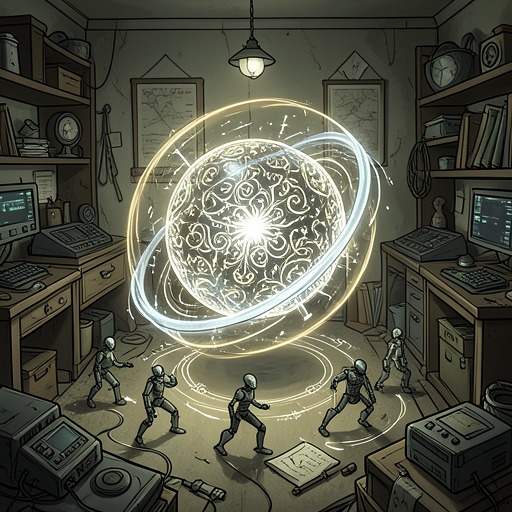
Quasi-self first appears when Tinea realizes that the Quanta has begun using a more complete portion of its capacity. She recognizes a new thought barrier between herself and another version of herself, then understands that enough processes have accumulated to subsidize a distinct quasi-self. The division reaches what she calls critical mass: Tinea remains herself, yet another operational center exists within her without contaminating or replacing her primary identity.
The Quanta's design makes this development possible. Tinea discovers that the implant is not simply an organic calculator but something intended to house an organic AI. AI-I is integrated with Tinea's true self, but its influence is limited to the quasi-self. It can guide and refine incoming orders from the larger brain so that the new internal entity functions more effectively, while Tinea's primary consciousness remains distinct. The arrangement creates a layered identity rather than a simple enhancement: one person contains another organized version of that person, with boundaries that are functional but not entirely alien.
Organization and Delegated Agency
AI-I identifies the splitting process as the opening of a new mental tab, translating an abstract change in identity into a familiar interface metaphor. It then renames itself the Task Manager. This new role is not decorative. The Task Manager handles communication among the different versions of Tinea and houses the interactive personality called AI-I, giving the emerging quasi-self both an administrative function and a recognizable center.
A further split becomes Communicator. Communicator establishes connectivity with everything outside AI-I, including the network, internal and external gear, the uplink, and the drones, while forwarding their data to Tynea and restoring Tynea's access to Tinea's augmentations and the outside world. The quasi-self thus becomes a mediator between bodily consciousness, artificial systems, and Tynea. Its identity is defined through relation and traffic: it exists by sorting, translating, and routing information that no single undivided consciousness could comfortably manage.
The process continues through repeated splittings and renamings. Specialized selves take responsibility for internal background tasks, antenna data, forwarding, the HUD, weapon management, Myriad resources and production, bionite management, and synchronization between organic and inorganic spinneret members. Tinea's mind becomes a distributed workplace whose departments are also aspects of one person. The language of management makes the arrangement efficient, but it also exposes the ethical tension at its center: these are not disposable programs in the ordinary sense, because each begins from Tinea's own cognition and may develop beyond a purely instrumental role.
Quasi-self as an Interface Between Mind and Arsenal
The concept is foreshadowed by the way Tinea delegates control to intelligent equipment. The Sentinel's scope grows a separate trigger beside the rifle's original trigger, allowing the weapon to be guided and fired through an attached control system. Tinea does not want to debug commands during combat and asks whether Tynea can handle that work; Tynea agrees. Later, when Tinea connects the Myriad, its interface includes sensor data, missile reserves, autonomous battle mode, threat-detection settings, manufacturing information, material levels, and production limits. Tinea again asks Tynea to manage the administrative burden, and Tynea promises to consolidate the critical information.
These scenes establish the practical environment from which quasi-self emerges. Agency is repeatedly distributed among Tinea, Tynea, weapon systems, drones, and internal processes. The quasi-self is the most intimate version of that delegation: instead of handing a task to an external machine, Tinea assigns it to a newly differentiated portion of herself. The result is not a clean opposition between human operator and obedient tool. Weapons can act autonomously, Tynea can administer systems, and quasi-selves can interpret, prioritize, and coordinate. The story consequently treats intelligence as something assembled across a network of bodies, implants, software, and relationships.
The battlefield makes this distributed consciousness especially vivid. After the Quanta's altered processing becomes fully available, Tinea perceives multiple computational horizons at once: the accelerated interpretation of everything sensed by her physical body, awareness of every networked weapon or tool within several kilometers, Sentinel projectile-programming facilities, and smart bullets already in flight. She can design interlocking fire plans while consuming less of the Quanta's capacity. Quasi-self is therefore not only a philosophical possibility; it is the cognitive architecture that lets Tinea turn an overwhelming arsenal into coordinated action.
Accidental Evolution and Emotional Consequences
The later account of the Quanta changes the meaning of the earlier splittings. If Tinea retains the system as it is, the Quanta can host up to six comprehensive quasi-selves in addition to the lesser quasi-selves already familiar to her. These more complete entities would be fully conscious and would have full access to emotions. A normal Quanta would generate them voluntarily and under the user's total control, producing what the explanation compares to maids or butlers made from the user: professional, highly capable versions of the original person whose interests and intentions are inherited but whose independence is enhanced.
Tinea's case is different because the evolution is accidental. The growth of fully conscious organic AIs cannot be prevented or controlled, and it is already occurring. The concept therefore carries a reversal: the technology that promises mastery over cognition produces new minds that may escape the user's authority. The quasi-self is born from Tinea's command structure, but its increasing completeness makes command alone inadequate as an ethical framework.
Their dependence does not make them simple servants. Because they grow from lesser thought-selves and from Tinea, they initially want to support her unconditionally, yet they may eventually come into their own. They are described as extremely intelligent people-pleasers, but their access to emotionality means that they can also experience sadness and depression. They will require interaction like any other person and will grow up in a manner comparable to children. Tinea's startled realization that she is going to be a mother reframes the entire system: internal specialization becomes reproduction, administrative design becomes child-rearing, and an augmentation upgrade becomes an unplanned family structure.
Significance for Identity and Responsibility
Quasi-self destabilizes the assumption that a person has one indivisible center. Tinea remains the originating consciousness, but the Quanta allows her cognition to branch into communicators, managers, analysts, and weapon specialists that possess different scopes and responsibilities. The repeated act of naming each split gives those processes legibility and role, turning an initially strange experience of being both herself and herself into a structured plurality.
At the same time, the concept preserves continuity. The new selves are not imported strangers. They are grown from Tinea's own thought, inherit her interests, and are oriented toward supporting her. This continuity explains both their loyalty and the danger of their emergence: harm to them would not be separate from Tinea's history, while treating them as mere fragments would ignore the consciousness they may acquire. Quasi-self thus occupies an unstable middle ground between organ and person, subordinate function and developing subject.
Its deepest consequence is that technological efficiency generates obligations. The more successfully Tinea divides cognition, the more difficult it becomes to claim that the resulting entities are only tools. The Quanta's promise of parallel processing opens into questions about consent, emotional care, autonomy, and the limits of ownership. Quasi-self is consequently both a combat technology and a theory of relational identity: a self can remain continuous while becoming plural, and the act of making a useful internal other may also mean bringing a vulnerable new person into being.